<?php
$PAGE_TITLE = "Which Novolac Epoxy Is Best? | Compare 630 vs 633 vs 632";
$HEAD_EXTRA = <<<'HTML'
HTML;

include $_SERVER['DOCUMENT_ROOT'].'/includes/header.php';
?>
<!-- META TAGS -->
<meta name="description" content="Compare Epoxy.com Novolac epoxies #630, #633, and #632 for chemical resistance, temperature tolerance, and flexibility. Find the right Novolac epoxy for your job." />
		<meta name="keywords" content="Novolac epoxy, epoxy coating, chemical resistant epoxy, epoxy joint filler, Epoxy.com 630, Epoxy.com 633, Epoxy.com 632, epoxy vs novolac comparison, epoxy resin for acid containment" />                          
<link rel="canonical" href="https://www.epoxy.com/technical-resources/which-novolac-epoxy-is-best.aspx" />
	
<!--
File: /technical-resources/which-novolac-epoxy-is-best.aspx
Purpose: Education page explaining selection of Novolac epoxies (#632 joint filler, #630 binder/coating, #633 coating)
-->

<!-- JSON-LD Structured Data (Primary) -->
<script type="application/ld+json">
{
  "@context": "https://schema.org",
  "@type": "Article",
  "headline": "Which Novolac Epoxy Is Best? | Compare 630 vs 633 vs 632",
  "description": "Compare Epoxy.com Novolac epoxies #630, #633, and #632 for chemical resistance, temperature tolerance, and flexibility to choose the right Novolac epoxy for your job.",
  "author": {
    "@type": "Person",
    "name": "Norm Lambert"
  },
  "publisher": {
    "@type": "Organization",
    "name": "Epoxy.com",
    "logo": {
      "@type": "ImageObject",
      "url": "https://www.epoxy.com/images/epoxy-com-logo.png"
    }
  },
  "mainEntityOfPage": {
    "@type": "WebPage",
    "@id": "https://www.epoxy.com/technical-resources/which-novolac-epoxy-is-best.aspx"
  },
  "datePublished": "2026-02-20",
  "dateModified": "2026-02-20"
}
</script>

<article class="container">
  <header>
    <h1>Which Novolac Epoxy Is Best?</h1>
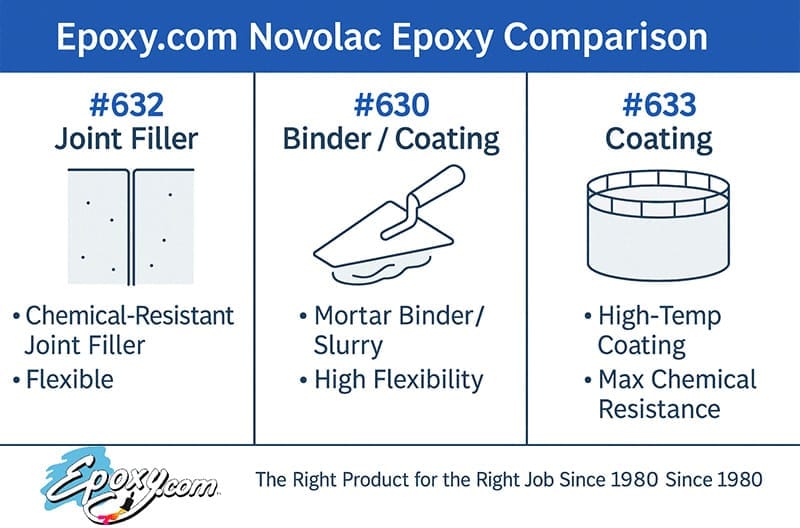
    <p><strong>Short answer:</strong> it depends on your application and exposure conditions. Each Novolac epoxy has different strengths across chemical resistance, temperature tolerance, and flexibility. Use this guide to decide whether <strong>#632</strong>, <strong>#630</strong>, or <strong>#633</strong> best fits your job.</p>
  </header>

  <section aria-labelledby="quick-selector">
    <h2 id="quick-selector">Quick Selector</h2>
    <table border="1" cellpadding="8" cellspacing="0">
      <thead>
        <tr>
          <th>Need</th>
          <th>Recommended Product</th>
          <th>Typical Use</th>
        </tr>
      </thead>
      <tbody>
        <tr>
          <td>Chemical-resistant joint filler</td>
          <td><a href="https://www.epoxy.com/632.aspx">#632 Novolac Control Joint Filler</a></td>
          <td>Saw-cut joints in slabs exposed to washdowns or chemical splash.</td>
        </tr>
        <tr>
          <td>Slurry/mortar binder or coating with flexibility</td>
          <td><a href="https://www.epoxy.com/630.aspx">#630 Novolac Binder/Coating</a></td>
          <td>Secondary containment, utilities, pulp and paper, harsh chemical areas.</td>
        </tr>
        <tr>
          <td>Maximum coating chemical and temperature resistance</td>
          <td><a href="https://www.epoxy.com/633.aspx">#633 Novolac Coating</a></td>
          <td>Pump pads, trenches, solvent storage, high-exposure zones.</td>
        </tr>
      </tbody>
    </table>
  </section>

  <section aria-labelledby="summaries">
    <h2 id="summaries">Product Summaries</h2>

    <h3>#632 &ndash; Novolac Control Joint Filler</h3>
    <p>100% solids, flexible Novolac epoxy designed for saw-cut joints in concrete floors that see chemical attack, thermal cycling, or frequent washdowns. Ideal where joint fillers must resist acids, caustics, or solvents without shrinking or brittle failure.</p>

    <h3>#630 &ndash; Novolac Binder / Coating</h3>
    <p>A 100% solids Novolac epoxy used as a troweled mortar, slurry binder, or coating on concrete and steel in extremely corrosive environments. Engineered for resistance to strong caustics and up to 98% sulfuric acid under proper design. Common in chemical plants, pulp mills, secondary containment, water and waste treatment, and power utilities. A conductive version is available for ESD-safe, chemical-resistant flooring.</p>

    <h3>#633 &ndash; Novolac Coating</h3>
    <p>A 100% solids Novolac epoxy coating for harsh chemical and solvent service: secondary containment, solvent storage, pump pads, trenches, and other high-exposure areas. Frequently used as a seal coat over epoxy mortar systems when maximum chemical and temperature resistance are required.</p>
  </section>

  <section aria-labelledby="compare-630-633">
    <h2 id="compare-630-633">Choosing Between #630 and #633</h2>
    <p>Both deliver superior performance in aggressive chemical service. Key differences:</p>

    <table border="1" cellpadding="8" cellspacing="0">
      <thead>
        <tr>
          <th>Property / Consideration</th>
          <th>#630 Binder/Coating</th>
          <th>#633 Coating</th>
        </tr>
      </thead>
      <tbody>
        <tr>
          <td>Primary Role</td>
          <td>Binder for slurry/mortar that can also coat</td>
          <td>Purpose-built coating; can seal mortar systems</td>
        </tr>
        <tr>
          <td>Flexibility</td>
          <td>More flexible</td>
          <td>Stiffer</td>
        </tr>
        <tr>
          <td>Clarity (clear)</td>
          <td>Stays clearer longer</td>
          <td>Ambers faster</td>
        </tr>
        <tr>
          <td>Chemical Resistance</td>
          <td>Excellent</td>
          <td>Slightly higher overall</td>
        </tr>
        <tr>
          <td>Temperature Resistance</td>
          <td>High</td>
          <td>Higher</td>
        </tr>
        <tr>
          <td>Best Fit</td>
          <td>When you need slurry/mortar build or some flexibility</td>
          <td>When you need maximum coating and temperature resistance</td>
        </tr>
      </tbody>
    </table>
  </section>

  <section aria-labelledby="applications">
    <h2 id="applications">Typical Applications</h2>
    <ul>
      <li><strong>#632 Joint Filler:</strong> Chemical plant floors, washdown areas, food and beverage plants, secondary containment slabs.</li>
      <li><strong>#630 Binder/Coating:</strong> Slurry resurfacers, secondary containment walls, trenches, utilities, pulp and paper mills, water and wastewater treatment.</li>
      <li><strong>#633 Coating:</strong> Top coats and seal coats for mortar systems, pump pads, solvent storage areas, high-temperature zones.</li>
    </ul>
  </section>

  <!-- New: Installation and Technical Notes (verbatim per user) -->
  <section aria-labelledby="installation">
	  
	  <!-- insert graphic 
	  <img src="https://www.epoxy.com/images/which-novolac-epoxy-comparison-800x420.jpg"
     srcset="https://www.epoxy.com/images/which-novolac-epoxy-comparison-1600x840.jpg 2x"
     alt="Epoxy.com Novolac Epoxy Comparison Chart #630 vs #633 (+ #632 Joint Filler)"
     width="800" height="420" loading="lazy" />
	  -->
	  
	  <img src="/images/which-novolac-epoxy-comparison-800x528.jpg"
     alt="Epoxy.com Novolac Epoxy Comparison Chart #630 vs #633 (+ #632 Joint Filler)"
     width="800" height="528" loading="lazy" />
	  <!-- insert graphic end -->


    <h2 id="installation">Installation &amp; Technical Notes</h2>
    <p>Proper mixing and installation is critical to the optimal success of all products.  See Installation Tips, Techdata, &amp; MSDS for more details on our products.  Be sure to contact us with any questions and/or concerns that you have.</p>
  </section>

  <section aria-labelledby="contact">
    <h2 id="contact">Talk to a Technical Specialist</h2>
    <p>For more information please contact:</p>
    <p><strong>Epoxy.com Technical Support</strong><br />
    Phone: <a href="tel:+13525332167">352-533-2167</a><br />
    Email: <a href="mailto:norm@epoxy.com">norm@epoxy.com</a></p>

    <p>Related product pages: <a href="https://www.epoxy.com/632.aspx">#632</a> | <a href="https://www.epoxy.com/630.aspx">#630</a> | <a href="https://www.epoxy.com/633.aspx">#633</a></p>

    <p style="margin-top:2em;"><a href="/technical-resources/default.aspx">&larr; Back to Technical Resources Home</a></p>
  </section>

  <!-- FAQ Schema for enhanced search results -->
  <script type="application/ld+json">
  {
    "@context": "https://schema.org",
    "@type": "FAQPage",
    "mainEntity": [
      {
        "@type": "Question",
        "name": "Which Novolac epoxy is best?",
        "acceptedAnswer": {
          "@type": "Answer",
          "text": "There is no single best Novolac epoxy. The right choice depends on chemical exposure, temperature, and application (joint filler, mortar/slurry, or coating)."
        }
      },
      {
        "@type": "Question",
        "name": "When should I use Product #632 instead of #630 or #633?",
        "acceptedAnswer": {
          "@type": "Answer",
          "text": "Use #632 for control joints that require chemical resistance and movement accommodation."
        }
      },
      {
        "@type": "Question",
        "name": "How do Product #630 and #633 differ?",
        "acceptedAnswer": {
          "@type": "Answer",
          "text": "#630 is a more flexible Novolac binder that also coats and stays clearer longer; it excels for slurry/mortar builds. #633 is a Novolac coating with slightly higher chemical and higher temperature resistance."
        }
      },
      {
        "@type": "Question",
        "name": "Is a conductive, chemical-resistant system available?",
        "acceptedAnswer": {
          "@type": "Answer",
          "text": "Yes. A conductive version of #630 is available for chemical-resistant ESD flooring."
        }
      }
    ]
  }
  </script>
</article>
<?php include $_SERVER['DOCUMENT_ROOT'].'/includes/footer.php'; ?>